


Coating Is More Than Just One Process
2026.09.30Coating & Slot Die
Five Application Scenarios That Show Why There Is No “Standard Answer” for Coating Equipment
Many customers come to us and say, “We need a coating line. Please provide the specifications and a quotation.”
It sounds like a straightforward request. However, although coating is a process, there is no single standard set of process conditions that applies to every application. Different applications and requirements call for different process conditions and equipment designs. Therefore, coating cannot be approached with a one-size-fits-all mindset.
When planning coating equipment, the starting point is often not “What kind of machine do we need?” but rather “What coating process do we need to accomplish?”
Materials are certainly one of the key factors determining the process, but different coating applications can also lead to very different equipment design requirements.
So, let’s take a closer look at several coating applications and see how the same “coating process” can result in very different equipment designs when the materials, substrates, and process conditions change.
Read More: What Exactly Is Coating? A Must-Read for Beginners! Quickly Dive into the World of Coating
Scenario 1: New Energy & Batteries — Even in Electrode Coating, the Cathode and Anode Are Different!
Lithium-ion batteries are one of the major applications of coating technology. The basic concept is to coat electrode slurry onto metal foil to create the functional electrode layers of the battery. However, what many people may not realize is that cathode and anode coating already involve two different sets of process conditions.
For cathode coating, commonly used active materials include NMC or LFP, combined with conductive additives and binders, with aluminum foil typically used as the substrate. For anode coating, graphite or silicon-containing materials are commonly used with different binder systems, while copper foil is typically used as the substrate.
Different coating materials mean different solids content, particle size, density, and sedimentation behavior. These differences affect mixing, circulation, filtration, slurry delivery, and drying time. As a result, the design of the slurry delivery pump, coating die, and drying oven may also differ. The thickness and mechanical properties of the substrates are different as well, requiring corresponding changes in unwinding, rewinding, and tension control
In battery electrode manufacturing, the key process requirements go beyond simply achieving a target coating thickness. Uniformity in both the cross-web and machine directions is also critical.
So, even though both are generally referred to as “lithium-ion battery coating,” cathode and anode coating clearly demonstrate a fundamental point: when the material changes, the coating process changes with it.
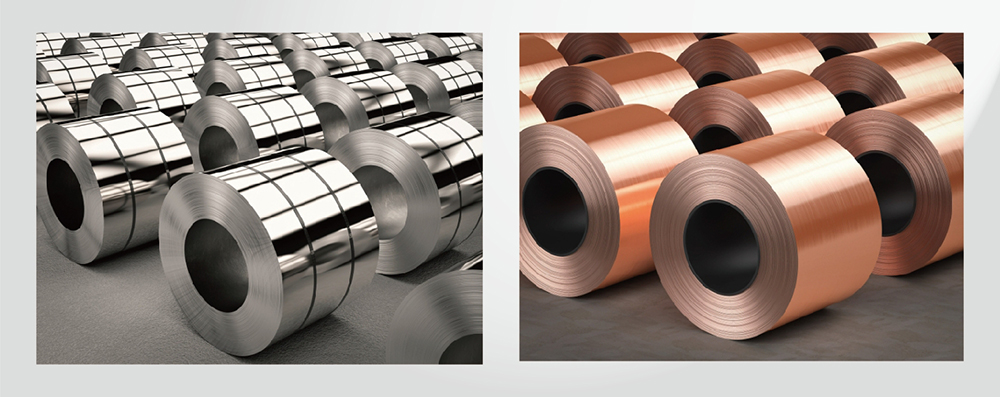
Even within battery coating, cathode and anode coating require different processes because of the different materials involved.
Scenario 2: Semiconductor Process Materials — Different Process Stages Require Different Coating Methods
The semiconductor industry attracts global attention. Across the entire supply chain, from wafer fabrication to advanced packaging and testing, a tiny chip must go through many different processes. Accordingly, the coating method can vary significantly depending on the stage of the semiconductor manufacturing process.
When people think of coating in semiconductor manufacturing, photoresist coating on silicon wafers is often the first example that comes to mind. This process mainly uses spin coating, in which the wafer rotates at high speed and centrifugal force is used to form a uniform, ultra-thin photoresist layer.
However, when we extend our view beyond the wafer itself to back-end semiconductor processes and advanced packaging, a wide range of functional films are also required, such as wafer processing tapes, protective films, and release films. Depending on their structure and functional requirements, these materials may require adhesive, release, protective, or other functional coatings, and are therefore produced using precision roll-to-roll coating processes.
Both are coating processes used in semiconductor manufacturing, but “forming a coating directly on the surface of a circular wafer” and “producing functional films required for semiconductor processes” represent two very different coating scenarios. As the product format, substrate, and process purpose change, the appropriate coating method changes accordingly.
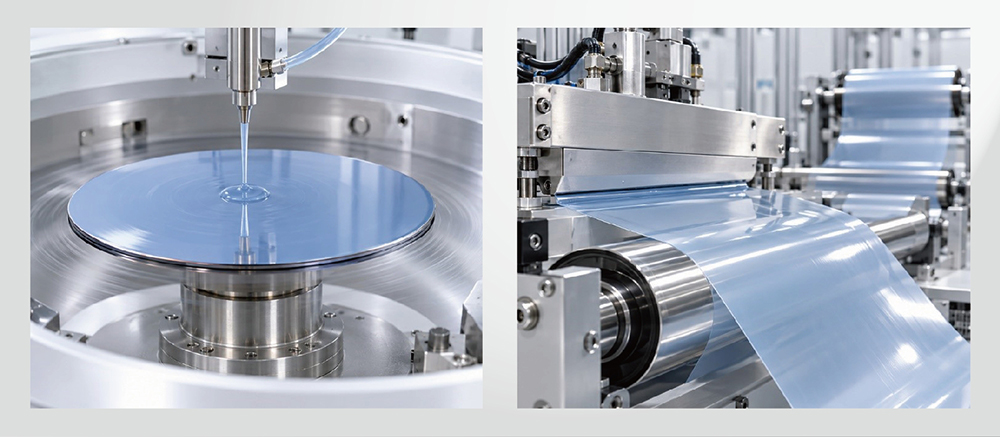
Different stages of semiconductor chip manufacturing require different coating methods. (Left) Spin coating on a silicon wafer. (Right) Roll-to-roll coating of various films used in chip packaging and testing. These images are illustrative and do not depict actual manufacturing processes.
Scenario 3: Display & Electronics Applications — When the Substrate Changes, the Coating Equipment Changes with It
Coating technologies used in display applications are closely related to optical performance, and one of the key characteristics of these products is their extreme sensitivity to appearance and uniformity. Even minor fluctuations in flow rate, changes in tension, variations in substrate thickness, or uneven drying can eventually result in visible brightness or color non-uniformity, streaks, or other optical defects.
Even within display applications, different substrates require different coating methods.
When the substrate is rigid glass, such as glass substrates used in touch panels, the process may involve conductive layers, photoresist, or other functional coatings. Cover glass for smartphones, tablets, and automotive displays may also require functional coatings such as anti-glare, anti-reflective, or anti-fingerprint coatings. These rigid, flat substrates require precision flat-panel coating.
When the substrate changes to a flexible film, such as PET or COP, the application may involve hard-coated films for display surface protection or other optical functional films. Because these products are manufactured continuously, the process shifts to precision roll-to-roll coating.
Therefore, even within the same display and electronics applications, simply changing the substrate from rigid glass to flexible film can lead to significant differences in substrate handling, coating methods, and the overall equipment configuration.
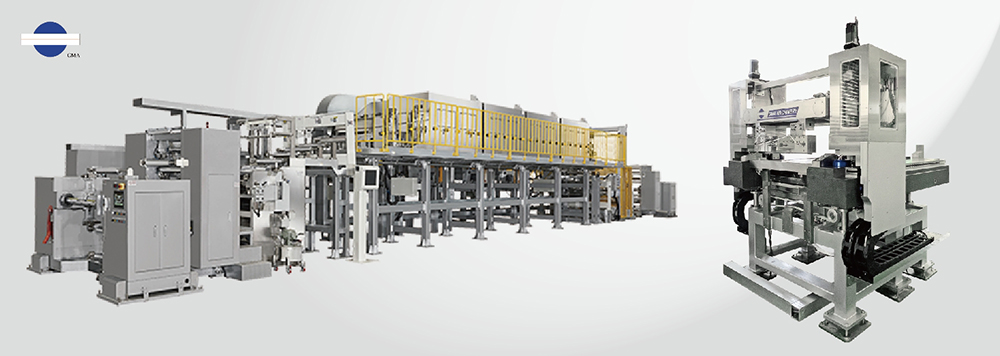
For the same display module application, a rigid glass substrate uses flat-panel coating (right), while a flexible film substrate uses roll-to-roll coating (left).
Read More: Behind the Light : Quality Commitment and Technology Behind Optical Products
Scenario 4: Flexible Packaging Materials — The Material System Changes the Equipment Specifications
In flexible packaging applications, coating is commonly used for adhesives, primers, barrier coatings, and other functional materials, adding properties such as adhesion, barrier performance, protection, or other specific functions to the substrate.
Compared with the semiconductor process materials or display and optical applications discussed earlier, flexible packaging generally places greater emphasis on production speed, output, and stable long-term continuous operation. Different coating methods, such as comma coating, micro gravure coating, and slot die coating, are suited to different material viscosities, coating weights, line speeds, and product requirements. Therefore, the question is not simply “Which coating method is better?” but rather “Which method is most suitable for the actual process conditions?”
In flexible packaging coating, another factor that can directly affect the configuration of the entire line is: What material system are you using?
Take adhesives as an example: they may be water-based, solvent-based, or solventless. Different material systems result in very different requirements for material feeding, coating, drying, and process safety.
Read More: Layer by Layer in a Drip Coffee Pouch: Extrusion, Lamination and Coating in Flexible Packaging
Scenario 5: Industrial & Functional Materials — Building Functionality Layer by Layer
Industrial and functional materials cover a wide range of products. One of the most distinctive characteristics of functional films is that their performance often comes not from the substrate itself, but from the functional coating layers applied to its surface.
Automotive paint protection film (PPF) is a typical example. Using TPU film as the substrate, different coating processes can be applied to provide functions such as self-healing, scratch resistance, weather resistance, and adhesion.
Another widely used example is decorative film made from PET, PVC, or PP, commonly found on furniture, cabinets, and doors. To improve durability, scratch-resistant, abrasion-resistant, or UV-curable coatings may be applied. To achieve specific surface gloss and tactile properties, matte or high-gloss coatings may also be used.
Industrial tapes, release films, and surface protection films follow the same concept: different materials and coating designs are used to give the substrate specific functions that it does not inherently possess.
The real challenge in these applications is not simply “Can the material be coated?” Instead, each layer must perform its intended function correctly, without negatively affecting the other coating layers.
 Functional layers created
through coating are widely used on furniture and door panels to provide scratch
resistance or maintain the desired surface smoothness and tactile feel
Functional layers created
through coating are widely used on furniture and door panels to provide scratch
resistance or maintain the desired surface smoothness and tactile feel
Coating Methods for Different Application Scenarios
|
Item |
New Energy & Batteries |
Semiconductor Process Materials |
Display & Electronics Applications |
Packaging Materials |
Industrial & Functional Materials |
|
Typical Substrates |
Copper Foil / Aluminum Foil |
Wafer / PET / PI Flexible Films |
Glass / PET Flexible Substrates |
PET / BOPP / Aluminum Foil |
TPU / PET, etc. |
|
Coating Type |
Roll-to-Roll Precision Coating |
Spin Coating (Wafer) / Roll-to-Roll Precision Coating (Functional Films) |
Flat-Panel Precision Coating / Roll-to-Roll Precision Coating |
Roll-to-Roll Precision Coating |
Roll-to-Roll Precision Coating |
|
Typical Coating Materials |
Electrode Slurry |
Photoresist / Adhesive, Release, Protective and Other Functional Coatings |
Photoresist / Hard Coatings / Optical Functional Coatings |
Adhesives / Primers / Barrier Coatings |
Scratch-Resistant / Abrasion-Resistant / Adhesive / Surface Functional Coatings |
|
Core Requirements |
Electrode Coating Uniformity and Stability |
Precision / Low Defects / Functional Stability |
Optical Uniformity and Appearance Quality |
Production Speed / Capacity / Continuous Operation |
Multi-Layer Functionality and Surface Performance |
|
Key Process Considerations |
Slurry Stability / Coating Uniformity / Tension / Drying Control |
Thin-Layer Uniformity / Defect Control / Substrate Stability |
Coating Uniformity / Appearance Defects / Substrate Control |
Coating Speed / Drying Capacity / Material System / Solvent Safety |
Coating Uniformity / Interlayer Compatibility / Surface Quality / Curing |
Therefore, before discussing the specifications of coating equipment, the following six key questions should first be clarified. Only then can we determine the appropriate specifications and evaluate the requirements for implementing a coating process.
1. What are you coating?
What are the material’s viscosity, solids content, particle size, and
rheological properties?
2. What are you coating it onto?
Is the substrate a flexible film, metal foil, paper, or a rigid substrate such
as glass?
3. How much do you need to coat?
Is the requirement defined by wet film thickness, dry film thickness, coating
weight, or areal density?
4. How much variation is
acceptable?
What are the acceptance criteria for uniformity, appearance, and defects?
5. How will it be dried or
cured?
Hot-air drying, UV curing, thermal curing, or another method?
6. What material system are you
using?
Is it water-based, solvent-based, or solventless? Are exhaust, LEL monitoring,
explosion protection, or other safety measures required?